Take-Two discloses Grand Theft Auto at 12.4% of revenue. EA, carrying the same risk, discloses nothing.
Six decisions your executive team is making right now — and the evidence on each
Written for the executive team at a games publisher, deciding about their own company. Each decision names the seat that owns it and the seat that contests it, carries sourced evidence, and states what would have to be true for the answer to flip.
Walk into planning with all six calls made, the evidence on each, and what your CEO, CFO and board will ask already answered.
An EDGAR full-text search of every 10-K filed since January 2025 returns six games companies that quantify franchise concentration. A disclosed percentage is the exception, which is why your board cannot benchmark you against your peers even if it wants to.
What is in it
- Live service, or premium releaseDomain 3 · CPO, contested with CEO on category entry and CFO on the investment case. EA's live-service line is 71% of revenue — and it shrank 1% in the year full-game revenue grew 7%.
- Premium, free-to-play, or subscriptionDomain 2 · CRO, contested with CFO on margin and CPO on packaging. $80 has held only where the publisher owns the platform or owns the event. The one large third-party AAA launch held at $70.
- Acquire studios, or build themDomain 11 · CEO, contested with CFO on valuation and financing. Eight acquired studios closed or divested in twenty-six months — four of them on a single day.
- Which storefront, and what take rate is tolerableDomain 4 · CRO, contested with CEO on sequencing and Legal on platform terms. Google's effective games take moved from 30% to 25%, and to 20% through an external link. Console rates are published by nobody.
- Where players now discover gamesDomain 12 · CRO, contested with CEO on public stance. Primary measurement for this brief: 25 AI answers. Metacritic, Polygon and Rock Paper Shotgun were cited zero times; Steam was cited three, and Nordic IGN appeared where IGN did not.
- Franchise concentrationDomain 9 · Risk, contested with CFO on economics. The 12.4% is a trough figure, and reading it as a run-rate is the mistake this section exists to prevent.
It closes with the executive decision matrix — CEO, CFO, CRO, CPO, Legal and Risk — each with something specific to do in this category, not a generic lens.
Check a decision yourself first
Most of these decisions have a paid run that measures part of it, fresh, with its controls and a citation line. Ask your AI assistant with the full CULT+MATH server connected (https://cultmath.com/mcp; the Claude and ChatGPT directory versions carry the free research only). It shows the price before anything is paid, and a run that fails its checks charges nothing. A run checks one piece of a decision; the brief answers the whole of it.
- Live service, or premium releaseAsk: “How has Electronic Arts' revenue mix moved over its last three 10-Ks?”
run_revenue_mixmeasures every revenue split the company files that adds up to reported revenue, across its three latest 10-Ks, with shares and dollars. It does not show revenue per title. - Premium, free-to-play, or subscriptionAsk: “How does Take-Two's revenue growth compare with Electronic Arts' and Roblox's?”
run_peer_benchmarkmeasures a company's metric for its latest fiscal year beside each peer's, the peer median, the gap and the rank, from filings as filed. It does not show how a price model would perform for your title. - Acquire studios, or build themAsk: “Has Take-Two written down what it bought?”
run_write_downsmeasures goodwill and intangible impairments by year, from the company's 10-K filings. It does not show whether a given studio paid back. - Which storefront, and what take rate is tolerableNo run measures take rates; the brief carries what the platforms disclose.
- Where players now discover gamesAsk: “Which sites do AI assistants cite when players ask which game to buy next?”
run_answer_sharemeasures the most-cited domains across ChatGPT, Claude, Gemini and Perplexity, asked live, twice each. It does not show sales that come from AI answers. - Franchise concentrationAsk: “Which revenue splits does Take-Two file, and how have they moved?”
run_revenue_mixmeasures every revenue split the company files that adds up to reported revenue, across its three latest 10-Ks. It does not show revenue by franchise, unless the company files it.
Two sample pages: the opening and the leadership close
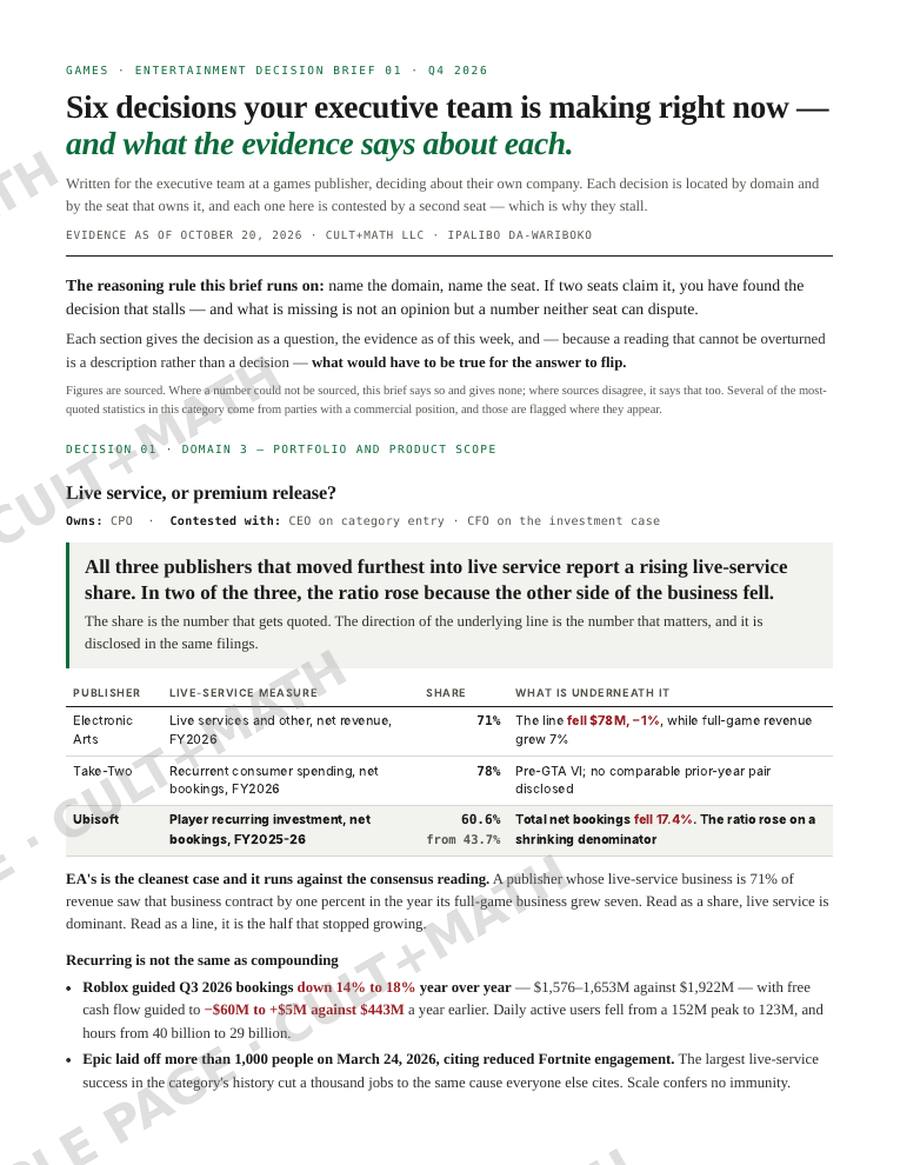
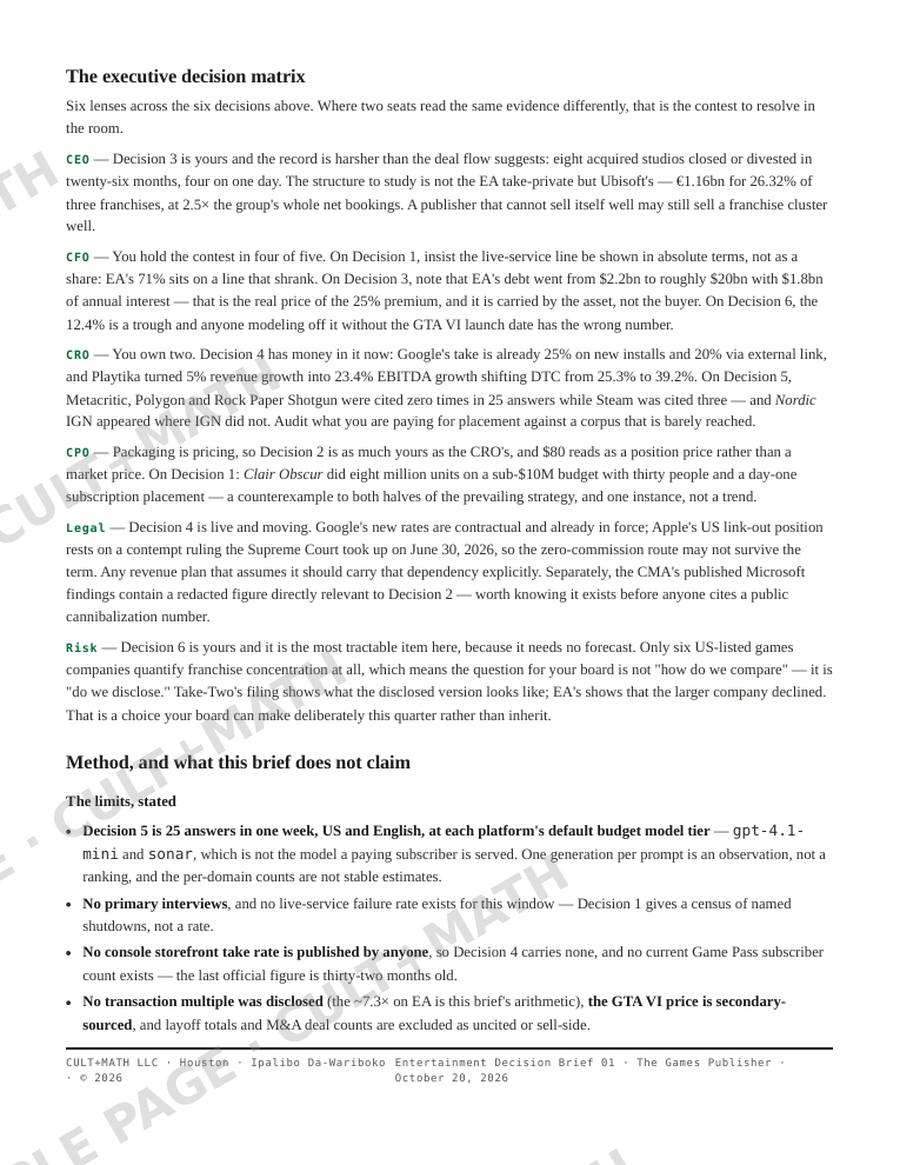
Read two of the questions in full, free, before you buy: How much of a games publisher's revenue coming from one franchise is too much? · Is live service or premium release the better model for a mid-size games publisher?
14-day guarantee. If the brief does not change or sharpen a decision on your desk, reply to your receipt within 14 days for a full refund. One refund per organization.
For comparison: the US average for a general management consultant runs $1,500–$4,000 a day. This is less than a third of one of those days, with the evidence already sourced.
Stripe receipt for expensing · card, Apple Pay, bank, Affirm or Klarna
What it is not
- Not a vendor ranking. It measures decisions and evidence, not which company is better.
- Not a forecast. Where something is an observation of one window, it says so.
- Not a market-size report. It will not tell you what any of this is worth to you in revenue.
- Not padded. 9 pages because that is what the evidence filled.
How the evidence is handled
Every figure is sourced. Where a number could not be sourced, the brief says so and gives none. Where two sources disagree on direction, it says that rather than picking the flattering one. Where a widely quoted statistic comes from a party with a commercial position, it is flagged — including where that flag weakens a point the brief is making.
The decision-maker and every decision were fixed before any source was read, and were not revised to fit what came back.
The catalogue briefs answer the decisions a category shares. A custom brief answers yours: one decision, one decision-maker, your market, with the question and what would prove it wrong registered before any data is pulled. See the custom brief, $995 →
Licensing. A $495 brief is licensed to one named reader — read it, quote it inside your organization, build on it in your own planning. To share the PDF across your organization, buy the team license ($1,495). No brief may be resold, published in full, or redistributed outside your organization. Quoting a figure externally is fine with attribution to CULT+MATH and the as-of date, which is the part that makes the figure meaningful.