The source was real. The number was real. It was a different company.
Six decisions your executive team is making right now — and the evidence on each
Written for the deal partner at a middle-market private equity firm — the seat that sponsors an investment to the committee and whose name is on the memo. Each decision names the seat that owns it and the seat that contests it, and the brief closes with what the investment committee will say when you bring it to them.
Walk into investment committee with all six calls made, the evidence on each, and the committee's questions already answered.
Not a model inventing numbers from nothing, which is the failure everyone already guards against. A cited, specific, internally confident answer about the wrong entity — twice, with working links, and a 90% spread between its own three answers. The second engine, asked the identical question, said plainly that the figure is not publicly disclosed. The brief carries both, and the two public-company controls that make the result a failure rather than a limitation.
What is in it
- How much diligence to buy, and where to point itWhere a sector's public comps disclose the lever you are underwriting, you can triangulate cheaply. Where they do not, primary diligence is the only route. Four sectors were measured before this brief and they do not behave the same way — and the rule that falls out is per-phrase, not per-sector.
- What to underwrite the growth lever asSome levers have public comps that demonstrably moved them and disclosed it. Others are asserted across an entire sector and appear in no filing. Net revenue retention is disclosed by 34 of roughly 6,900 filers and falling; retail media is up 3.6× and genuinely reported. One belongs in a base case and one does not.
- What to shift into reps, warranties, escrow and earnoutRepresentations and warranties insurance rose elevenfold as a share of all filers since 2015. Earnouts rose two and a half times. Working capital adjustments — the mechanism that settles numbers both sides can compute — fell 31%. Risk is moving onto the mechanisms that cover what cannot be verified.
- What discount concentration deserves, and whether a benchmark existsEleven of twelve large consumer filers publish their exposure to one retailer. None of the twelve publish their exposure to one brand. In the segment where it was measured directly, top-customer concentration ran from 23% to 74%. There is no normal, so the discount is argued rather than benchmarked.
- Whether demand is defensible, and whether your own team can see itPrimary measurement for this brief, with two public-company controls. Across twenty-five generations on companies whose figures sit in an annual report, neither engine cited sec.gov once. On a private target, one engine returned another company's financials with working citations.
- Whether an exit multiple can be underwritten at allTwo acquirers in a three-year window disclosed a multiple. A $1.95bn purchase and a $1.2bn purchase were both completed with no revenue published for either. Meanwhile "strategic alternatives" grew 60% in share of filers, so deal supply is rising while computability is not.
It closes with the executive decision matrix — CEO, CFO, CRO, CPO, Legal and Risk — each with something specific to do in this category, not a generic lens.
Check a decision yourself first
Most of these decisions have a paid run that measures part of it, fresh, with its controls and a citation line. Ask your AI assistant with the full CULT+MATH server connected (https://cultmath.com/mcp; the Claude and ChatGPT directory versions carry the free research only). It shows the price before anything is paid, and a run that fails its checks charges nothing. A run checks one piece of a decision; the brief answers the whole of it.
- How much diligence to buy, and where to point itAsk: “Which public CPG companies disclose velocity in their filings?”
run_disclosure_checkmeasures which filers use the phrase in their filings over the years given, with the first and latest filing linked. It does not show whether the target's own figure is right. - What to underwrite the growth lever asAsk: “How does Celsius's revenue growth compare with Keurig Dr Pepper's, PepsiCo's and Coca-Cola's?”
run_peer_benchmarkmeasures a company's metric for its latest fiscal year beside each peer's, the peer median, the gap and the rank, from filings as filed. It does not show whether the lever will keep working. - What to shift into reps, warranties, escrow and earnoutAsk: “How many 10-K filers mention earnouts, year by year?”
run_filing_trendmeasures the share of US 10-K filers that mention the phrase, year by year, from SEC EDGAR. It does not show the terms or pricing of any deal. - What discount concentration deserves, and whether a benchmark existsAsk: “How much of General Mills' revenue comes from its largest customer?”
run_customer_concentrationmeasures the largest customer's share of revenue in each of a public company's three latest 10-Ks. It does not show the target's own concentration, or what discount it deserves. - Whether demand is defensible, and whether your own team can see itAsk: “Is demand for protein snacks growing faster than search as a whole?”
run_demand_checkmeasures the category's year-on-year search change against an everyday basket of unrelated searches, with a 10-K cross-check. It does not show the target's share of that demand. - Whether an exit multiple can be underwritten at allAsk: “Is M&A in consumer packaged goods rising or falling, and who is buying?”
run_deal_activitymeasures merger-agreement filings that mention the sector, quarter by quarter, and the most active filers. It does not show deal values or exit multiples.
Two sample pages: the opening and the leadership close
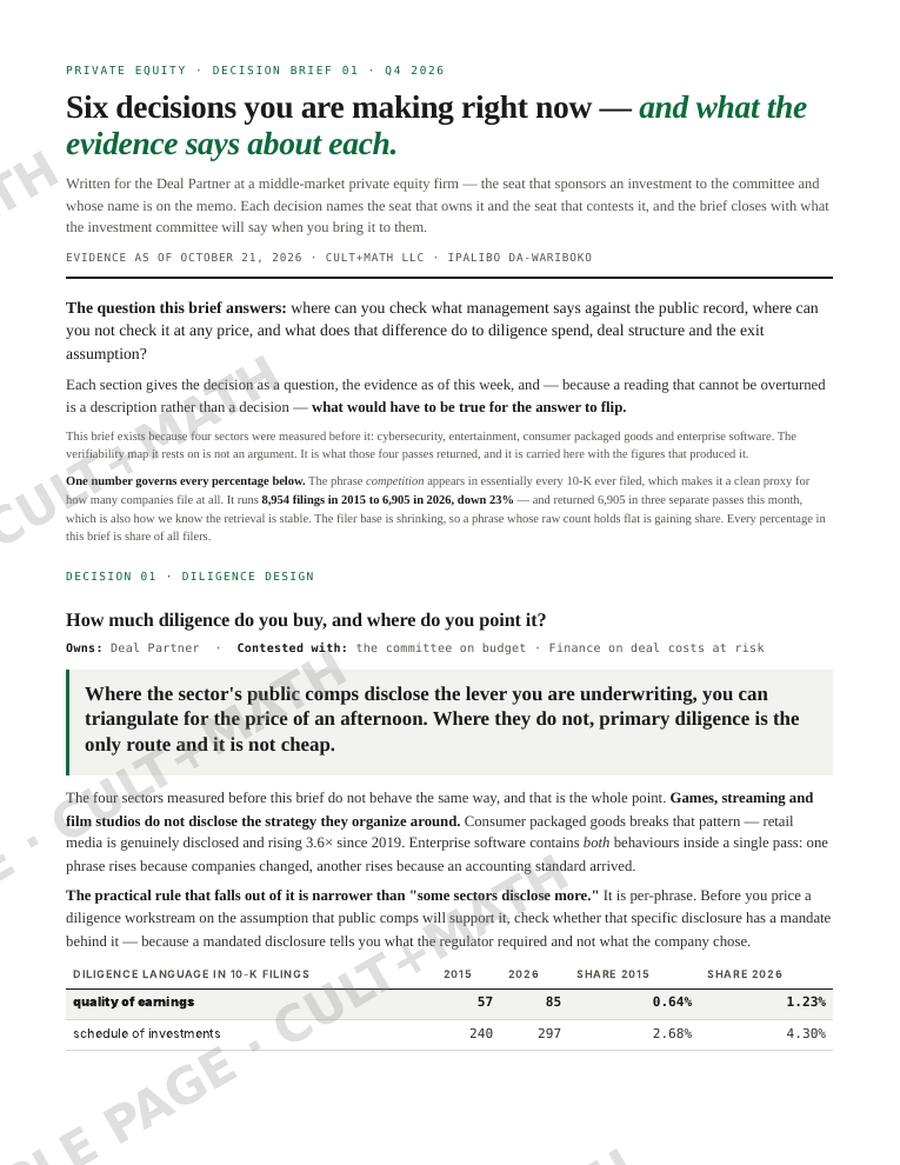
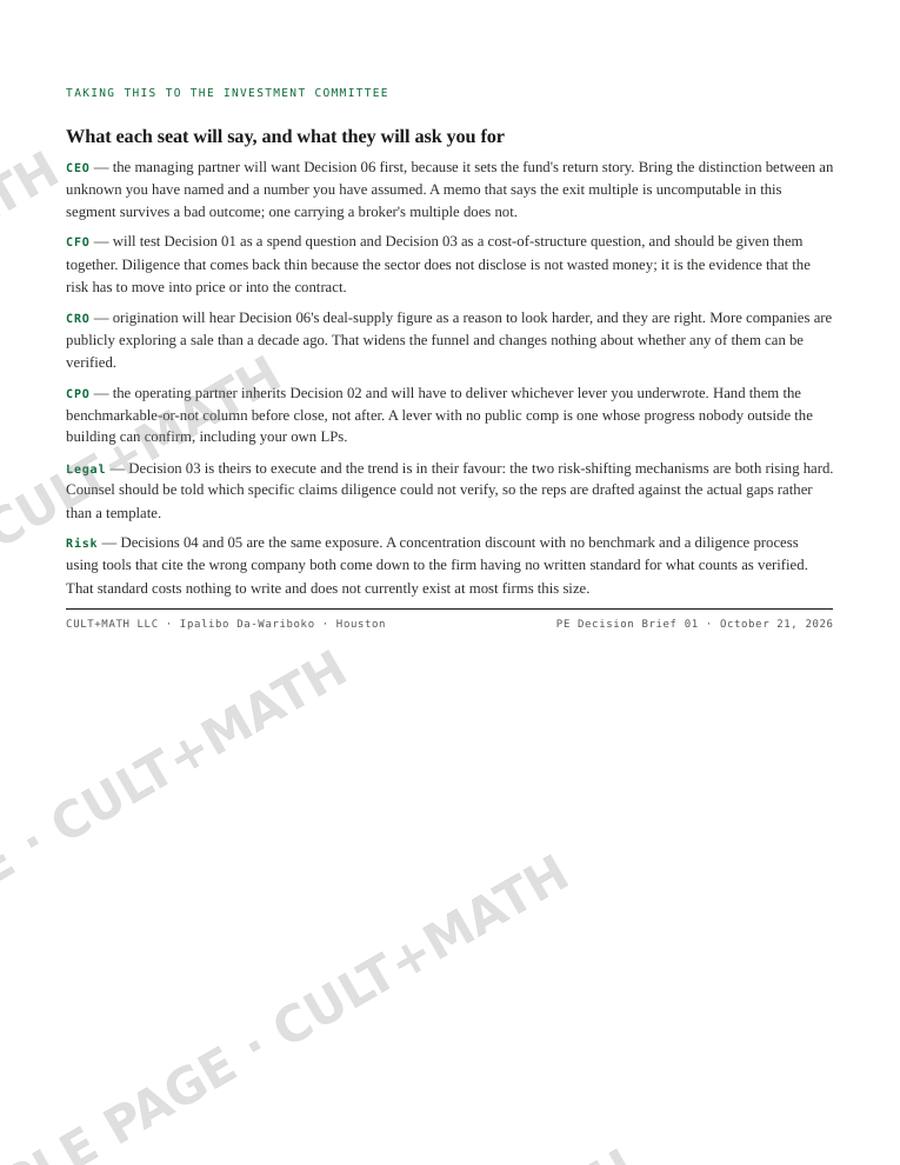
Read two of the questions in full, free, before you buy: How should a deal team weigh an earnout against reps and warranties insurance? · What does a private equity firm actually check during due diligence?
14-day guarantee. If the brief does not change or sharpen a decision on your desk, reply to your receipt within 14 days for a full refund. One refund per organization.
For comparison: commercial due diligence typically runs $20,000 for a desk-research project to $150,000 or more with a top-tier interview program. This is the market check before you commission it.
Stripe receipt for expensing · card, Apple Pay, bank, Affirm or Klarna
What it is not
- Not a vendor ranking. It measures decisions and evidence, not which company is better.
- Not a forecast. Where something is an observation of one window, it says so.
- Not a market-size report. It will not tell you what any of this is worth to you in revenue.
- Not padded. 7 pages because that is what the evidence filled.
How the evidence is handled
Every figure is sourced. Where a number could not be sourced, the brief says so and gives none. Where two sources disagree on direction, it says that rather than picking the flattering one. Where a widely quoted statistic comes from a party with a commercial position, it is flagged — including where that flag weakens a point the brief is making.
The decision-maker and every decision were fixed before any source was read, and were not revised to fit what came back.
The catalogue briefs answer the decisions a category shares. A custom brief answers yours: one decision, one decision-maker, your market, with the question and what would prove it wrong registered before any data is pulled. See the custom brief, $995 →
Licensing. A $495 brief is licensed to one named reader — read it, quote it inside your organization, build on it in your own planning. To share the PDF across your organization, buy the team license ($1,495). No brief may be resold, published in full, or redistributed outside your organization. Quoting a figure externally is fine with attribution to CULT+MATH and the as-of date, which is the part that makes the figure meaningful.