Your analyst and review budget bought zero citations in twenty-five AI answers.
Six decisions your executive team is making right now — and the evidence on each
Written for the Chief Revenue Officer of a mid-market ERP or business-software vendor — the seat that owns the number and signs off on how it gets made. Each decision names the seat that owns it and the seat that contests it, and the brief closes with what your CEO, your CFO and your product organization will say when you bring it to them.
Walk into the pipeline and budget review with all six calls made, the evidence on each, and what your CEO, CFO and product leaders will ask already answered.
Five questions a real mid-market ERP buyer types, scored before retrieval against G2, Capterra, SoftwareAdvice, Gartner, SelectHub and Reddit. The only hits were two Reddit citations on one question. Twelve of the twenty-five answers cited nothing at all — and the brief shows the mechanical reason why, which has a direct consequence for where content spend can and cannot reach.
What is in it
- Direct sales, channel, or both — and at what splitDomain 4 · CRO, contested with Finance on margin and the partner organization on account conflict. "Channel partners" grew 48% as a share of all filers while "value added reseller" lost 40% of its share. The structure is expanding and the word for it is being retired.
- How hard to price the on-prem to cloud migrationDomain 2 · CRO with Finance, contested with the CFO on revenue recognition. Your buyer arrives anchored at $150,000–$750,000, and the nine sources that set that anchor are implementation and development firms. "Cloud migration" peaked in filings in 2023 and has fallen a third since.
- AI as a priced module, a bundled feature, or a repositioningDomain 3 · CRO with the CPO, contested with Product on roadmap feasibility. 56.29% of all 10-K filers now say artificial intelligence, against a flat control and no disclosure mandate. Across twenty-five AI-generated ERP shortlists it justified one recommendation, in a sentence sourced to an implementation partner's blog.
- Vertical depth, or horizontal breadthDomain 3 · CRO with the CEO, contested with Product on engineering cost. Marked the thinnest decision in the brief and carrying demand-side measurement only. Every generation sorted vendors by production model rather than by size or price, and three vendors hold the horizontal position in ten of twenty-five answers.
- Where buyers now discover and shortlist an ERPDomain 12 · CRO, contested with Marketing on budget. Primary measurement for this brief: zero citations to G2, Capterra, SoftwareAdvice, Gartner or SelectHub across twenty-five generations, and twelve of those generations cited nothing whatsoever — for a reason the brief traces to token counts rather than to editorial choice.
- Customer and partner concentrationDomain 9 · CRO with Finance, contested with the board on risk disclosure. "Net revenue retention" appears in 34 of roughly 6,900 annual filings, peaked in 2022 and is falling. The metric your valuation turns on has no peer set in the public record.
It closes with the executive decision matrix — CEO, CFO, CRO, CPO, Legal and Risk — each with something specific to do in this category, not a generic lens.
Check a decision yourself first
Most of these decisions have a paid run that measures part of it, fresh, with its controls and a citation line. Ask your AI assistant with the full CULT+MATH server connected (https://cultmath.com/mcp; the Claude and ChatGPT directory versions carry the free research only). It shows the price before anything is paid, and a run that fails its checks charges nothing. A run checks one piece of a decision; the brief answers the whole of it.
- Direct sales, channel, or both — and at what splitAsk: “When buyers search for ERP for manufacturers, do they land on vendors, review sites or partners?”
run_channel_mixmeasures where the first page of Google sends buyers for one to three searches, by type of site. It does not show channel revenue or partner margins. - How hard to price the on-prem to cloud migrationAsk: “How many 10-K filers mention cloud migration, year by year?”
run_filing_trendmeasures the share of US 10-K filers that mention the phrase, year by year, from SEC EDGAR. It does not show what a migration should cost the customer. - AI as a priced module, a bundled feature, or a repositioningAsk: “How many 10-K filers now mention artificial intelligence?”
run_filing_trendmeasures the share of US 10-K filers that mention the phrase, year by year, from SEC EDGAR. It does not show what buyers will pay for an AI module. - Vertical depth, or horizontal breadthAsk: “Which industries do buyers search for ERP with, and which is growing?”
run_angle_demandmeasures each angle's share of category searches and its growth against an everyday control basket. It does not show the engineering cost of going vertical. - Where buyers now discover and shortlist an ERPAsk: “Which vendors and sites do AI assistants cite when a buyer asks for an ERP shortlist?”
run_answer_sharemeasures the most-cited domains across ChatGPT, Claude, Gemini and Perplexity, asked live, twice each. It does not show pipeline that comes from AI answers. - Customer and partner concentrationAsk: “Which software companies disclose net revenue retention in their filings?”
run_disclosure_checkmeasures which filers use the phrase in their filings over the years given, with the first and latest filing linked. It does not show any company's concentration.
Two sample pages: the opening and the leadership close
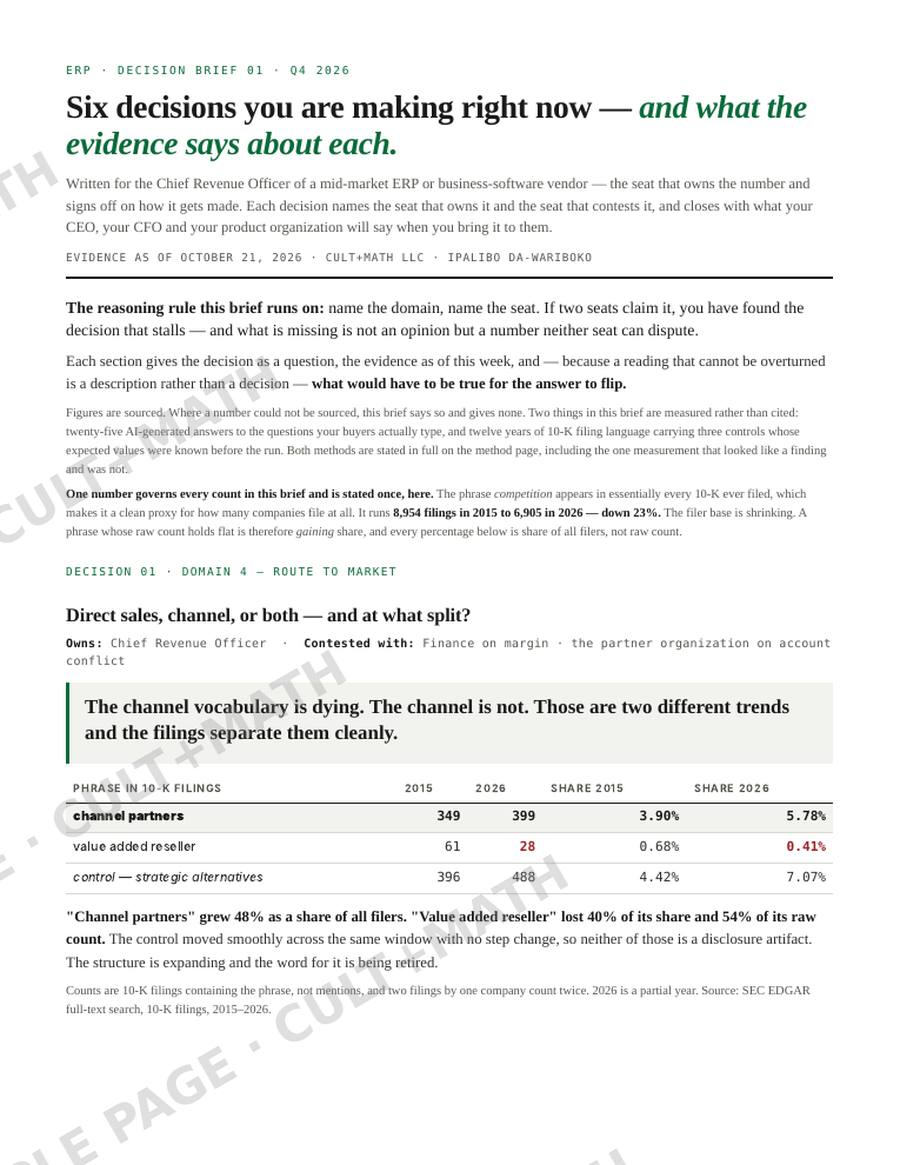
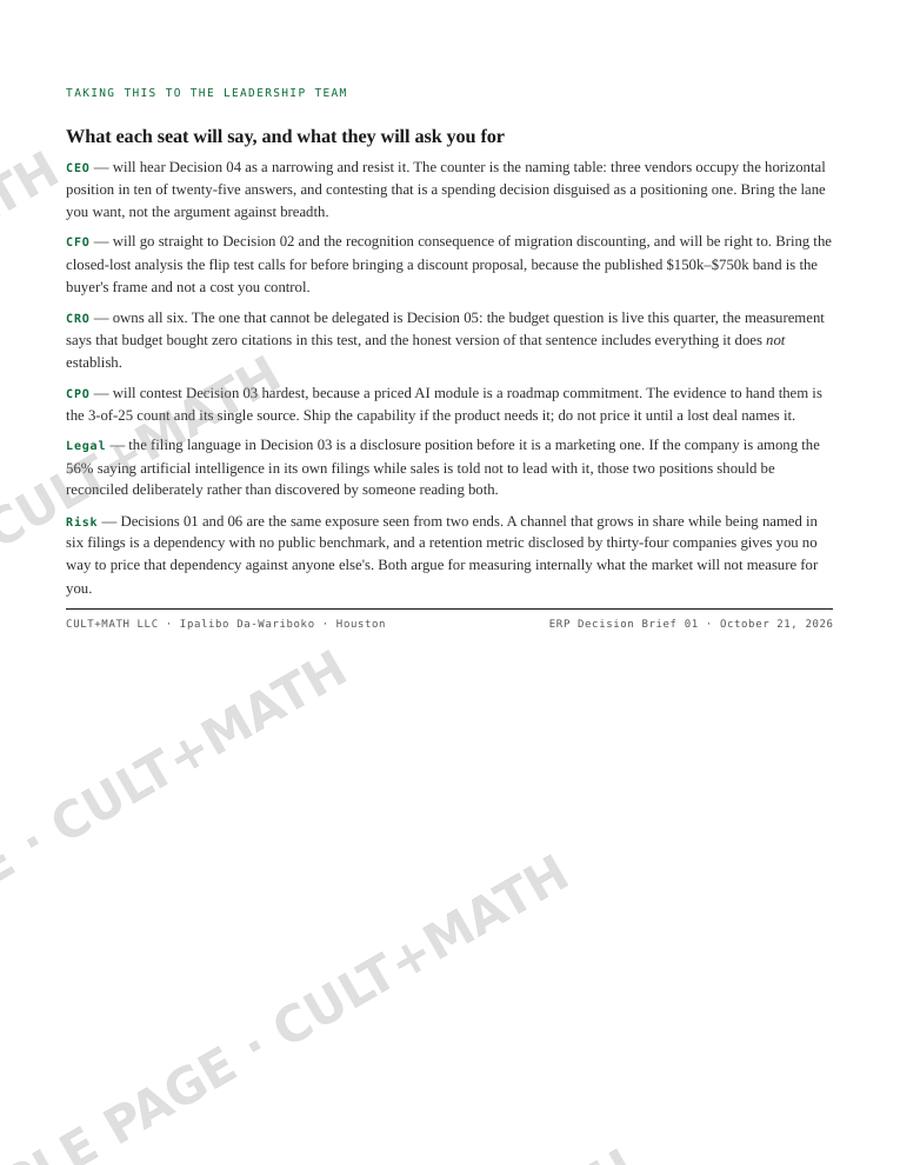
Read two of the questions in full, free, before you buy: How should an ERP vendor price a migration from a legacy system? · Should a B2B software company sell direct or through channel partners?
14-day guarantee. If the brief does not change or sharpen a decision on your desk, reply to your receipt within 14 days for a full refund. One refund per organization.
For comparison: a single Gartner for IT Leaders advisor seat lists at $49,576 a year on Gartner's federal price schedule. This brief costs 1% of that, and tests whether the analyst budget is reaching the answers your buyers now read.
Stripe receipt for expensing · card, Apple Pay, bank, Affirm or Klarna
What it is not
- Not a vendor ranking. It measures decisions and evidence, not which company is better.
- Not a forecast. Where something is an observation of one window, it says so.
- Not a market-size report. It will not tell you what any of this is worth to you in revenue.
- Not padded. 8 pages because that is what the evidence filled.
How the evidence is handled
Every figure is sourced. Where a number could not be sourced, the brief says so and gives none. Where two sources disagree on direction, it says that rather than picking the flattering one. Where a widely quoted statistic comes from a party with a commercial position, it is flagged — including where that flag weakens a point the brief is making.
The decision-maker and every decision were fixed before any source was read, and were not revised to fit what came back.
The catalogue briefs answer the decisions a category shares. A custom brief answers yours: one decision, one decision-maker, your market, with the question and what would prove it wrong registered before any data is pulled. See the custom brief, $995 →
Licensing. A $495 brief is licensed to one named reader — read it, quote it inside your organization, build on it in your own planning. To share the PDF across your organization, buy the team license ($1,495). No brief may be resold, published in full, or redistributed outside your organization. Quoting a figure externally is fine with attribution to CULT+MATH and the as-of date, which is the part that makes the figure meaningful.