California's $750m incentive went live in July 2025. Los Angeles shoot days still fell 12%.
Six decisions your executive team is making right now — and the evidence on each
Written for the executive team at a film and television studio — a company that produces, whether or not it distributes. Each decision names the seat that owns it and the seat that contests it, and states what would have to be true for the answer to flip.
Walk into planning with all six calls made, the evidence on each, and what your CEO, CFO and board will ask already answered.
The studies behind these programs disagree by an order of magnitude, and the split runs along who commissioned them: the studios' own trade body reports a 4.4× to 8.4× return, while New York's own department of taxation found 31 cents on the dollar and negative 10,635 jobs.
What is in it
- Theatrical window, or straight to streamingDomain 4 · CRO, contested with CEO on sequencing. Windows are lengthening, not shortening — every disclosed move in this cycle runs opposite to the 2021 consensus. The premise underneath them has never been measured.
- Own the IP, or take the work-for-hire feeDomain 3 · CPO, contested with CEO on the strategic read and CFO on the investment case. There is no audited cost-plus margin anywhere in the public record. The number your model runs on came from trade press.
- Sell the company, or stay independentDomain 11 · CEO, contested with CFO on valuation. No multiple was disclosed on any independent-studio transaction in three years — and three of the studios that reached a terminal event did not get there through a sale.
- Where production happens, and what the incentive is worthDomain 5 · Risk and CFO, contested with CPO on specification consequences. A three-seat contest, and the only decision in the set where the governing numbers are published by law.
- Where audiences now discover titlesDomain 12 · CRO, contested with CEO on public stance. Across 25 AI answers, Variety, The Hollywood Reporter and Deadline were cited zero times, and Rotten Tomatoes' editorial subdomain outcited its main domain two to one.
- Title and talent concentrationDomain 9 · Risk, contested with CFO on economics. Lionsgate asserts the risk and quantifies none of it — ten years after the same risk cut its movie-unit earnings from $166.9m to $49.5m in a quarter.
It closes with the executive decision matrix — CEO, CFO, CRO, CPO, Legal and Risk — each with something specific to do in this category, not a generic lens.
Check a decision yourself first
Most of these decisions have a paid run that measures part of it, fresh, with its controls and a citation line. Ask your AI assistant with the full CULT+MATH server connected (https://cultmath.com/mcp; the Claude and ChatGPT directory versions carry the free research only). It shows the price before anything is paid, and a run that fails its checks charges nothing. A run checks one piece of a decision; the brief answers the whole of it.
- Theatrical window, or straight to streamingAsk: “Is interest in our last release lasting, or past its peak?”
run_fad_checkmeasures how much of its best 12 months the title keeps today, on US Google Trends and English Wikipedia, with controls and a verdict. It does not show box office or streaming revenue. - Own the IP, or take the work-for-hire feeAsk: “Did the sequel lift searches for the original film?”
run_launch_liftmeasures the parent title's US search change in the launch month, against a seasonal control and a +20% bar set before the pull. It does not show what the IP is worth. - Sell the company, or stay independentAsk: “Is M&A among film studios rising or falling, and who is buying?”
run_deal_activitymeasures merger-agreement filings that mention the sector, quarter by quarter, and the most active filers. It does not show deal values or valuation multiples. - Where production happens, and what the incentive is worthNo run measures production incentives; they are state programs, outside the runs' federal sources.
- Where audiences now discover titlesAsk: “Which sites do AI assistants cite when people ask what film to see?”
run_answer_sharemeasures the most-cited domains across ChatGPT, Claude, Gemini and Perplexity, asked live, twice each. It does not show tickets that come from AI answers. - Title and talent concentrationNo run measures it: studios assert the risk and quantify none of it, which is the brief's finding.
Two sample pages: the opening and the leadership close
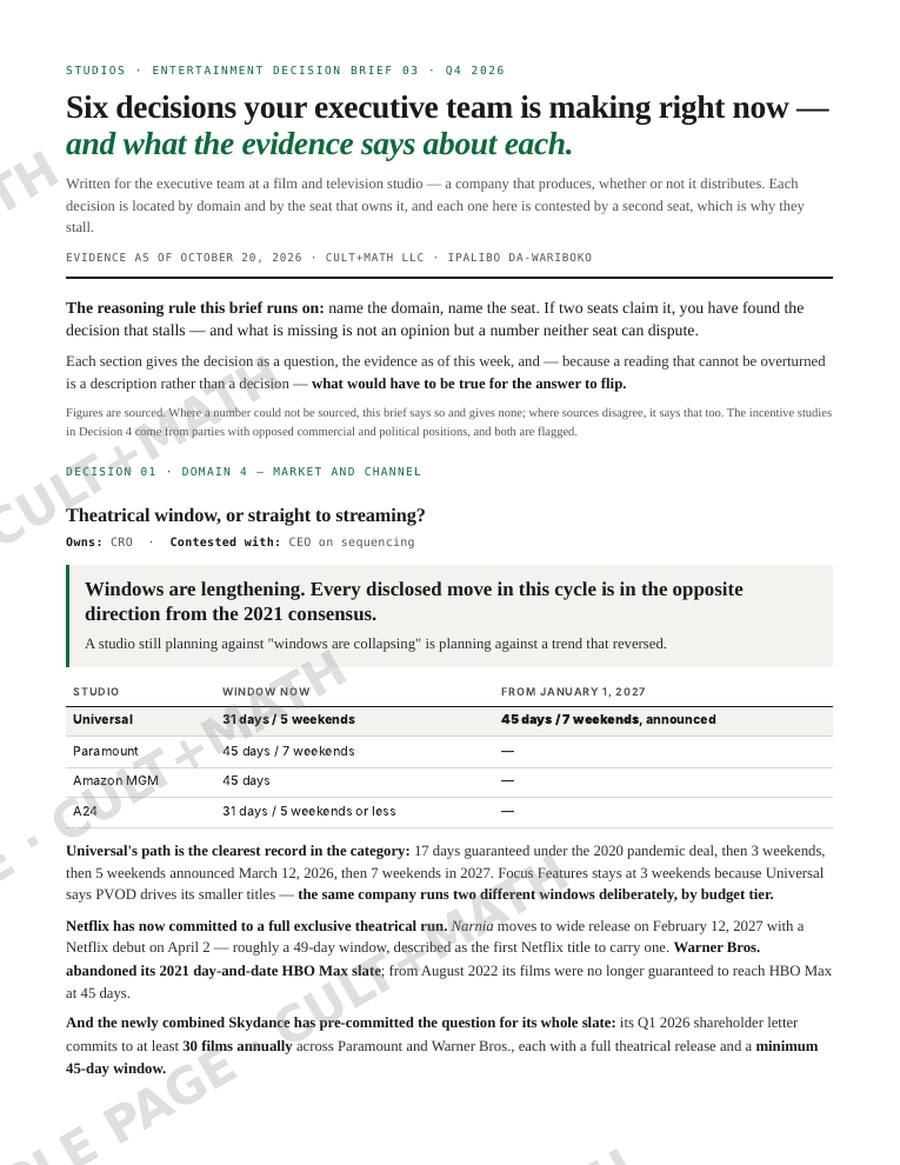
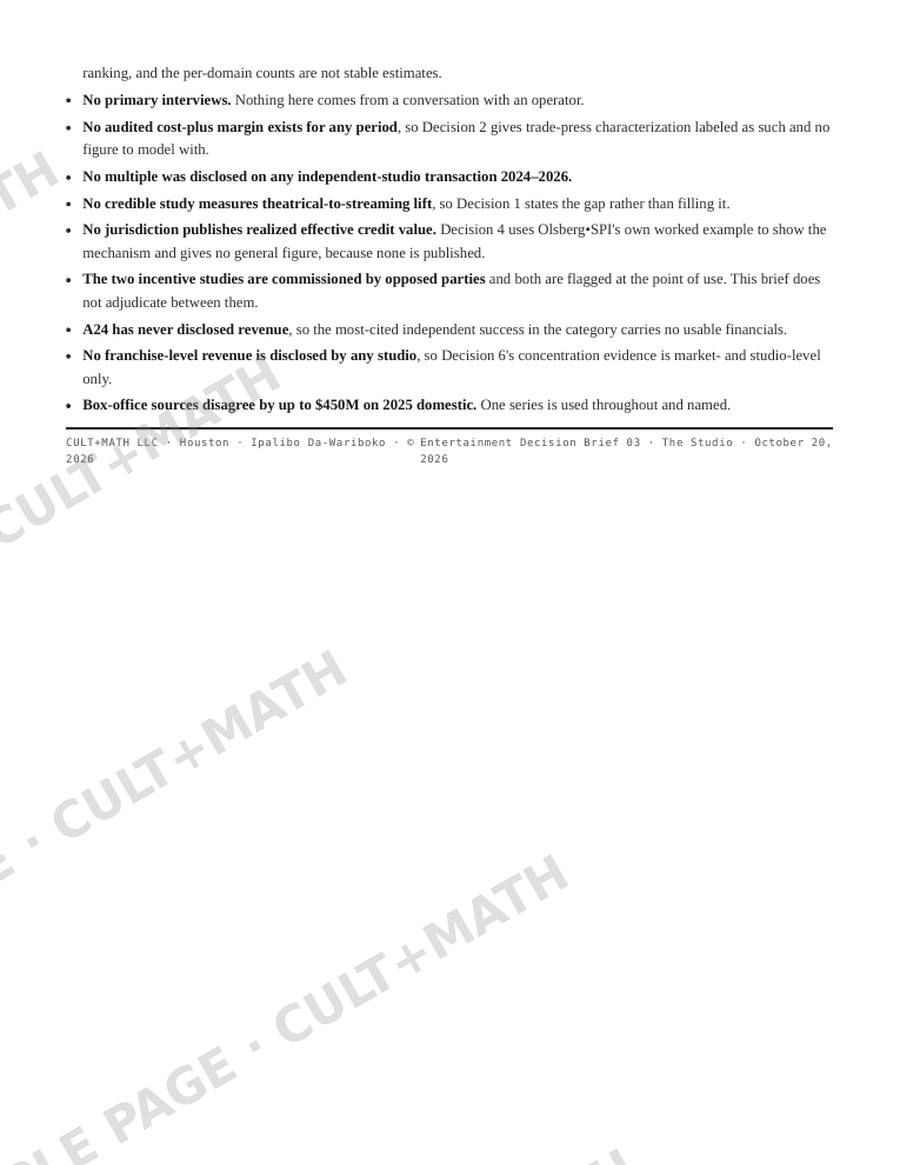
Read two of the questions in full, free, before you buy: Should an independent film studio keep its IP or take a work-for-hire fee from a streamer? · How long should a theatrical window be before a film goes to streaming?
14-day guarantee. If the brief does not change or sharpen a decision on your desk, reply to your receipt within 14 days for a full refund. One refund per organization.
For comparison: the US average for a general management consultant runs $1,500–$4,000 a day. This is less than a third of one of those days, with the evidence already sourced.
Stripe receipt for expensing · card, Apple Pay, bank, Affirm or Klarna
What it is not
- Not a vendor ranking. It measures decisions and evidence, not which company is better.
- Not a forecast. Where something is an observation of one window, it says so.
- Not a market-size report. It will not tell you what any of this is worth to you in revenue.
- Not padded. 10 pages because that is what the evidence filled.
How the evidence is handled
Every figure is sourced. Where a number could not be sourced, the brief says so and gives none. Where two sources disagree on direction, it says that rather than picking the flattering one. Where a widely quoted statistic comes from a party with a commercial position, it is flagged — including where that flag weakens a point the brief is making.
The decision-maker and every decision were fixed before any source was read, and were not revised to fit what came back.
The catalogue briefs answer the decisions a category shares. A custom brief answers yours: one decision, one decision-maker, your market, with the question and what would prove it wrong registered before any data is pulled. See the custom brief, $995 →
Licensing. A $495 brief is licensed to one named reader — read it, quote it inside your organization, build on it in your own planning. To share the PDF across your organization, buy the team license ($1,495). No brief may be resold, published in full, or redistributed outside your organization. Quoting a figure externally is fine with attribution to CULT+MATH and the as-of date, which is the part that makes the figure meaningful.