PepsiCo paid $1.95bn for poppi and $1.2bn for Siete. The multiples were never published.
Six decisions your executive team is making right now — and the evidence on each
Written for the founder or CEO of a premium consumer brand that has not been acquired and is not acquiring. Each decision names the seat that owns it and the seat that contests it, carries sourced evidence, and states what would have to be true for the answer to flip.
Walk into the next board meeting or acquirer conversation knowing which numbers are real, which are estimated, and the six calls in front of you.
The prices are knowable and the multiples are not. Every other number you will be quoted in a negotiation is derived, estimated or invented — and the brief names which two are real, on page one, before the first decision.
What is in it
- DTC, retail, or both — and when to crossDomain 4 · CEO, contested with Finance on burn. Olaplex is the only brand in the segment publishing a clean three-way split, and it says DTC neither saved the business nor sank it. No credible CAC benchmark exists anywhere in the field.
- Sell, raise, or stay independentDomain 11 · CEO, contested with the board on valuation. Two disclosed multiples in three years: 12× fully synergized EBITDA, and roughly 3× projected net revenue. Everything else is uncomputable from the filings.
- Hero SKU, or line extensionDomain 3 · Founder or CPO, contested with Sales on the shelf story. Vital Farms ran this experiment in public for four years: extensions moved the core down two points and then stopped. BellRing runs 85.9% of net sales through one brand at roughly $2bn of scale.
- Co-manufacture, or own the plantDomain 5 · CEO with Finance, contested with Ops on quality control. A single contract manufacturer produced products accounting for 54% of Olaplex's net sales. The one company that publicly reversed an owned-plant strategy never published what it saved.
- Where buyers now discover the brandDomain 12 · CEO. Premium brands are named abundantly by AI assistants and not through any source you could have placed. Asked about premium snacks, ChatGPT cited two bicycle retailers and a stock-photo CDN.
- Retailer and SKU concentrationDomain 9 · CEO, contested with Finance on economics. Top-customer concentration in this segment runs from 23% to 74% — there is no normal. Celsius published two consecutive years showing its dependence falling, which is worth more in a diligence room than any single-year number.
It closes with the executive decision matrix — CEO, CFO, CRO, CPO, Legal and Risk — each with something specific to do in this category, not a generic lens.
Check a decision yourself first
Most of these decisions have a paid run that measures part of it, fresh, with its controls and a citation line. Ask your AI assistant with the full CULT+MATH server connected (https://cultmath.com/mcp; the Claude and ChatGPT directory versions carry the free research only). It shows the price before anything is paid, and a run that fails its checks charges nothing. A run checks one piece of a decision; the brief answers the whole of it.
- DTC, retail, or both — and when to crossAsk: “When people search for our category, do they land on retailers, review sites or brand sites?”
run_channel_mixmeasures where the first page of Google sends buyers for one to three category searches, by type of site. It does not show channel profitability or acquisition cost. - Sell, raise, or stay independentAsk: “Is M&A in consumer packaged goods rising or falling, and who is buying?”
run_deal_activitymeasures merger-agreement filings that mention the sector, quarter by quarter, and the most active filers. It does not show deal values or valuation multiples. - Hero SKU, or line extensionAsk: “Did our last line extension lift searches for the brand it came from?”
run_launch_liftmeasures the parent brand's US search change in the launch month, against a seasonal control and a +20% bar set before the pull. It does not show extension revenue, or whether it took sales from the core. - Co-manufacture, or own the plantNo run measures plant economics. The brief carries what the filings disclose.
- Where buyers now discover the brandAsk: “Which brands and sites do AI assistants cite when buyers ask about our category, and where does our site stand?”
run_answer_sharemeasures the most-cited domains across ChatGPT, Claude, Gemini and Perplexity, asked live, twice each. It does not show sales that come from AI answers. - Retailer and SKU concentrationAsk: “How much of Procter & Gamble's revenue comes from its largest customer?”
run_customer_concentrationmeasures the largest customer's share of revenue in each of a public peer's three latest 10-Ks. It does not show your own concentration, or any private company's.
Two sample pages: the opening and the leadership close
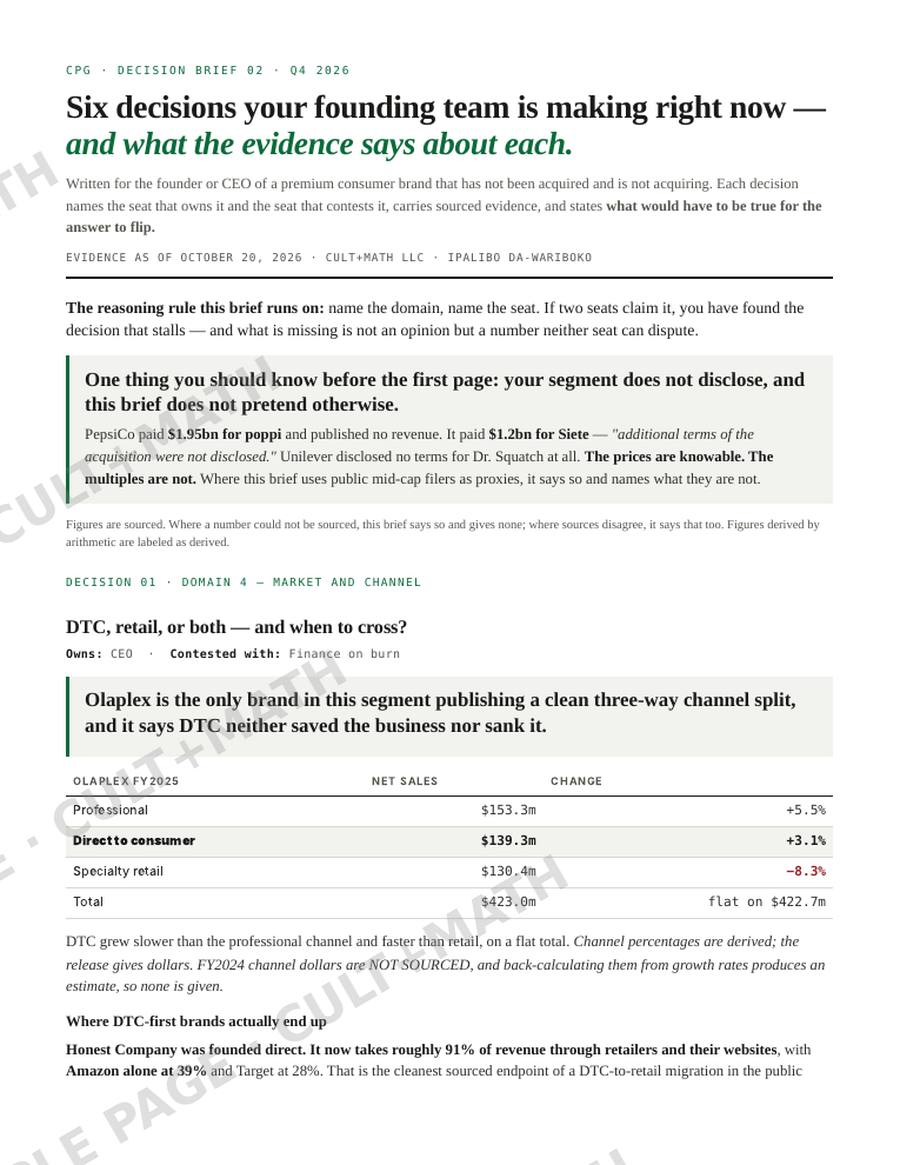
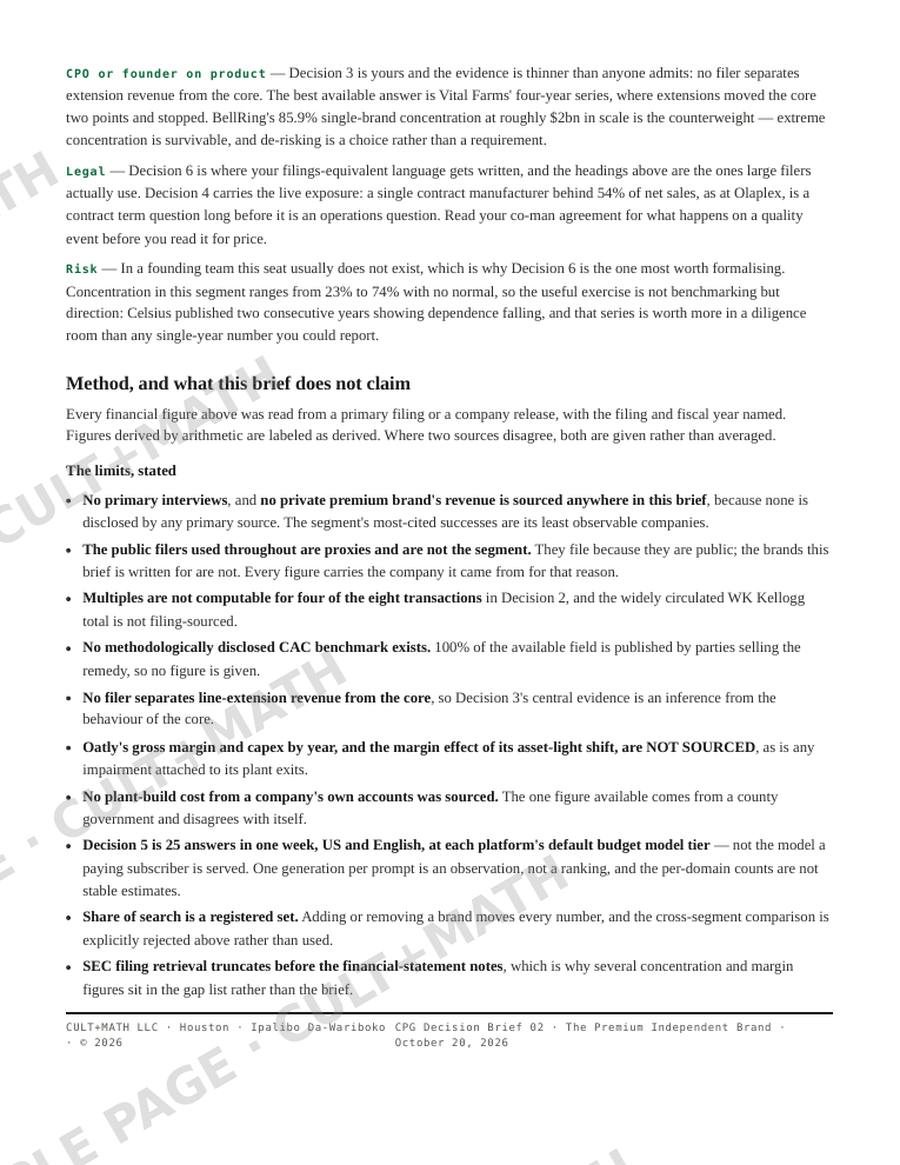
Read two of the questions in full, free, before you buy: Should a premium food brand sell direct to consumer or through retailers? · Should a premium consumer brand sell to a strategic acquirer or stay independent?
14-day guarantee. If the brief does not change or sharpen a decision on your desk, reply to your receipt within 14 days for a full refund. One refund per organization.
For comparison: the US average for a general management consultant runs $1,500–$4,000 a day. This is less than a third of one of those days, with the evidence already sourced.
Stripe receipt for expensing · card, Apple Pay, bank, Affirm or Klarna
What it is not
- Not a vendor ranking. It measures decisions and evidence, not which company is better.
- Not a forecast. Where something is an observation of one window, it says so.
- Not a market-size report. It will not tell you what any of this is worth to you in revenue.
- Not padded. 8 pages because that is what the evidence filled.
How the evidence is handled
Every figure is sourced. Where a number could not be sourced, the brief says so and gives none. Where two sources disagree on direction, it says that rather than picking the flattering one. Where a widely quoted statistic comes from a party with a commercial position, it is flagged — including where that flag weakens a point the brief is making.
The decision-maker and every decision were fixed before any source was read, and were not revised to fit what came back.
The catalogue briefs answer the decisions a category shares. A custom brief answers yours: one decision, one decision-maker, your market, with the question and what would prove it wrong registered before any data is pulled. See the custom brief, $995 →
Licensing. A $495 brief is licensed to one named reader — read it, quote it inside your organization, build on it in your own planning. To share the PDF across your organization, buy the team license ($1,495). No brief may be resold, published in full, or redistributed outside your organization. Quoting a figure externally is fine with attribution to CULT+MATH and the as-of date, which is the part that makes the figure meaningful.