Eleven of twelve large CPG filers disclose their exposure to one retailer. None disclose their exposure to one brand.
Six decisions your executive team is making right now — and the evidence on each
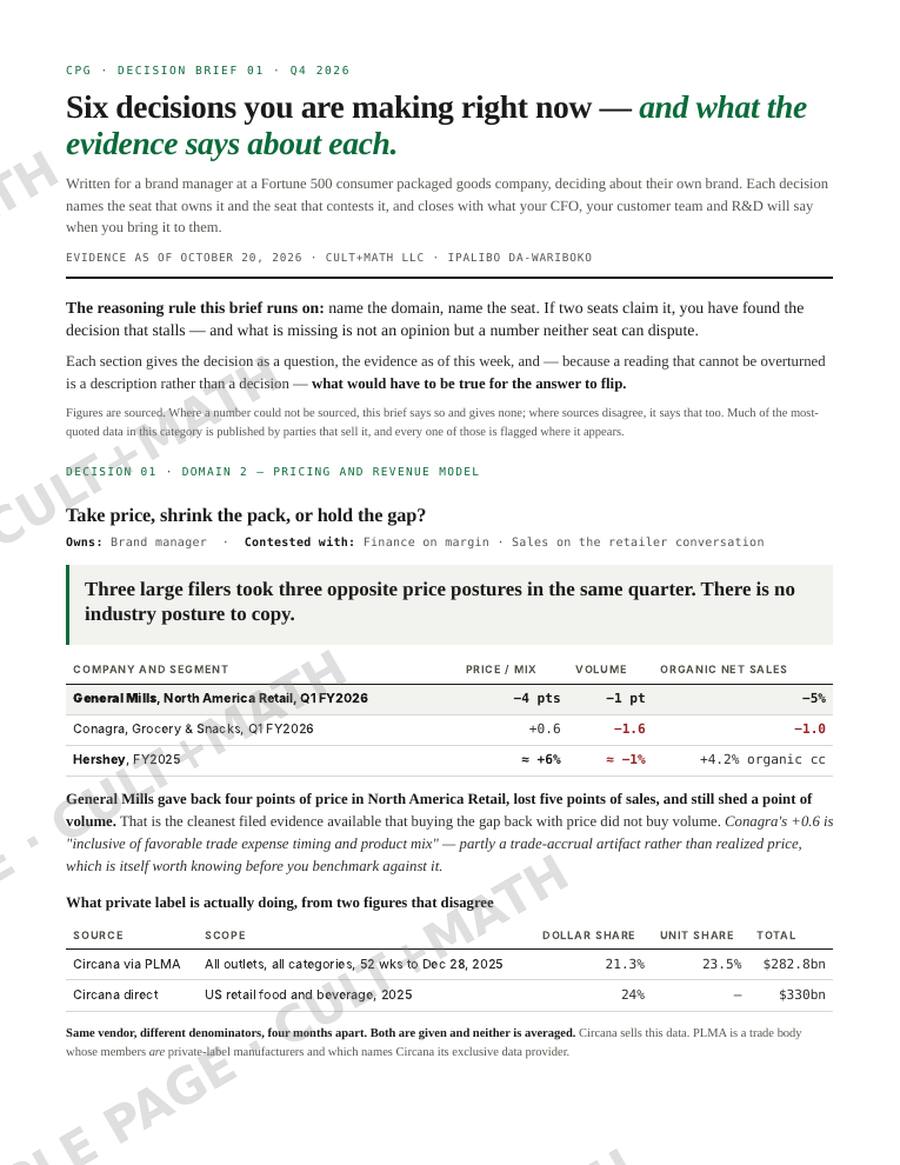
Written for a brand manager at a Fortune 500 consumer packaged goods company, deciding about their own brand. Each decision names the seat that owns it and the seat that contests it, and the brief closes with what your CFO, your customer team and R&D will say when you bring it to them.
Walk into the next pricing review with all six calls made, the evidence on each, and what your CFO, customer team and R&D will ask already answered.
The disclosure regime requires your company to measure the risk it does not control and permits it to ignore the one it does — and the second is the one you actually own. The brief carries the full twelve-filer table, including the three cautions that stop a false comparison.
What is in it
- Take price, shrink the pack, or hold the gapDomain 2 · Brand manager, contested with Finance on margin and Sales on the retailer conversation. Three large filers took three opposite price postures in the same quarter. General Mills gave back four points of price in North America Retail and still lost volume. Updated October 26: the lever now measures as spent in both directions — candy and gum prices rose 44% over five years against 22.5% for all food at home and gross margin still fell, while a 3% cut on one subcategory this season returned no volume at all.
- Renovate the core, or launch newDomain 3 · Contested with R&D on feasibility and category leadership on slotting. The "80% of new products fail" figure is a documented myth, and the peer-reviewed paper names why it survives: the self-interest of the people who repeat it.
- Trade spend, or retail mediaDomain 4 · Contested with Sales on the customer relationship. Trade spend is contra-revenue and structurally invisible; the accounting line that names it appears in two 10-K filings a year. No comparison between the two budgets reconciles to any filing.
- Absorb input cost, pass it through, or reformulate to costDomain 5 · Brand manager with Finance, contested with R&D on specification. Hershey took roughly six points of price in 2025 and lost about 610 basis points of adjusted gross margin anyway. Two reformulations in twelve months, one held, one reversed.
- Where shoppers now discover the brandDomain 12 · Contested with shopper marketing on budget. Primary measurement for this brief: ChatGPT answered all fifteen shopper questions citing no source at all, and still named competitor brands.
- Retailer and SKU concentrationDomain 9 · Contested with Finance on economics. Your Walmart exposure is published and anyone can look it up in twenty minutes. Your brand's exposure to one SKU is known to nobody outside the building.
It closes with the executive decision matrix — CEO, CFO, CRO, CPO, Legal and Risk — each with something specific to do in this category, not a generic lens.
Check a decision yourself first
Most of these decisions have a paid run that measures part of it, fresh, with its controls and a citation line. Ask your AI assistant with the full CULT+MATH server connected (https://cultmath.com/mcp; the Claude and ChatGPT directory versions carry the free research only). It shows the price before anything is paid, and a run that fails its checks charges nothing. A run checks one piece of a decision; the brief answers the whole of it.
- Take price, shrink the pack, or hold the gapAsk: “Are shoppers searching for a cheaper way into our brand more than a year ago?”
run_premium_checkmeasures price-seeking searches as a share of the brand's searches, against the year before. It does not show sales volume or price elasticity.
Ask: “What are the odds food-at-home prices are more than 3% above a year earlier in the next CPI release?”run_threshold_oddsmeasures a probability from the model's own tested errors, up to three months past the latest figure, beside two simple benchmarks. It does not show your category's own prices. - Renovate the core, or launch newAsk: “Which reason to buy is growing in our category: high protein, low sugar or gut health?”
run_angle_demandmeasures each angle's share of category searches and its growth against an everyday control basket. It does not show purchase intent or what a renovation would sell.
Ask: “Did our last launch lift searches for the core brand?”run_launch_liftmeasures the parent brand's US search change in the launch month, against a seasonal control. It does not show launch revenue. - Trade spend, or retail mediaAsk: “How much of the first page for our category's searches belongs to retailers?”
run_channel_mixmeasures where the first page of Google sends buyers for one to three category searches, by type of site. It does not show the return on trade spend or retail media. - Absorb input cost, pass it through, or reformulate to costAsk: “Did the cocoa price spike squeeze Hershey's gross margin?”
run_cost_squeezemeasures the commodity's yearly price change beside a public company's gross margin since 2019, with a verdict. It does not show your own costs, or which lever the company pulled. - Where shoppers now discover the brandAsk: “Which brands and sites do AI assistants cite when shoppers ask about our category?”
run_answer_sharemeasures the most-cited domains across ChatGPT, Claude, Gemini and Perplexity, asked live, twice each. It does not show sales that come from AI answers. - Retailer and SKU concentrationAsk: “How much of General Mills' revenue comes from its largest customer?”
run_customer_concentrationmeasures the largest customer's share of revenue in each of a public company's three latest 10-Ks. It does not show sKU concentration, which no filing discloses.
Two sample pages: the opening and the leadership close
Read two of the questions in full, free, before you buy: Should a packaged food brand pass cost increases through to price? · How much of a packaged food brand's sales going through one retailer is too risky?
14-day guarantee. If the brief does not change or sharpen a decision on your desk, reply to your receipt within 14 days for a full refund. One refund per organization.
For comparison: the US average for a general management consultant runs $1,500–$4,000 a day. This is less than a third of one of those days, with the evidence already sourced.
Stripe receipt for expensing · card, Apple Pay, bank, Affirm or Klarna
What it is not
- Not a vendor ranking. It measures decisions and evidence, not which company is better.
- Not a forecast. Where something is an observation of one window, it says so.
- Not a market-size report. It will not tell you what any of this is worth to you in revenue.
- Not padded. 9 pages because that is what the evidence filled.
How the evidence is handled
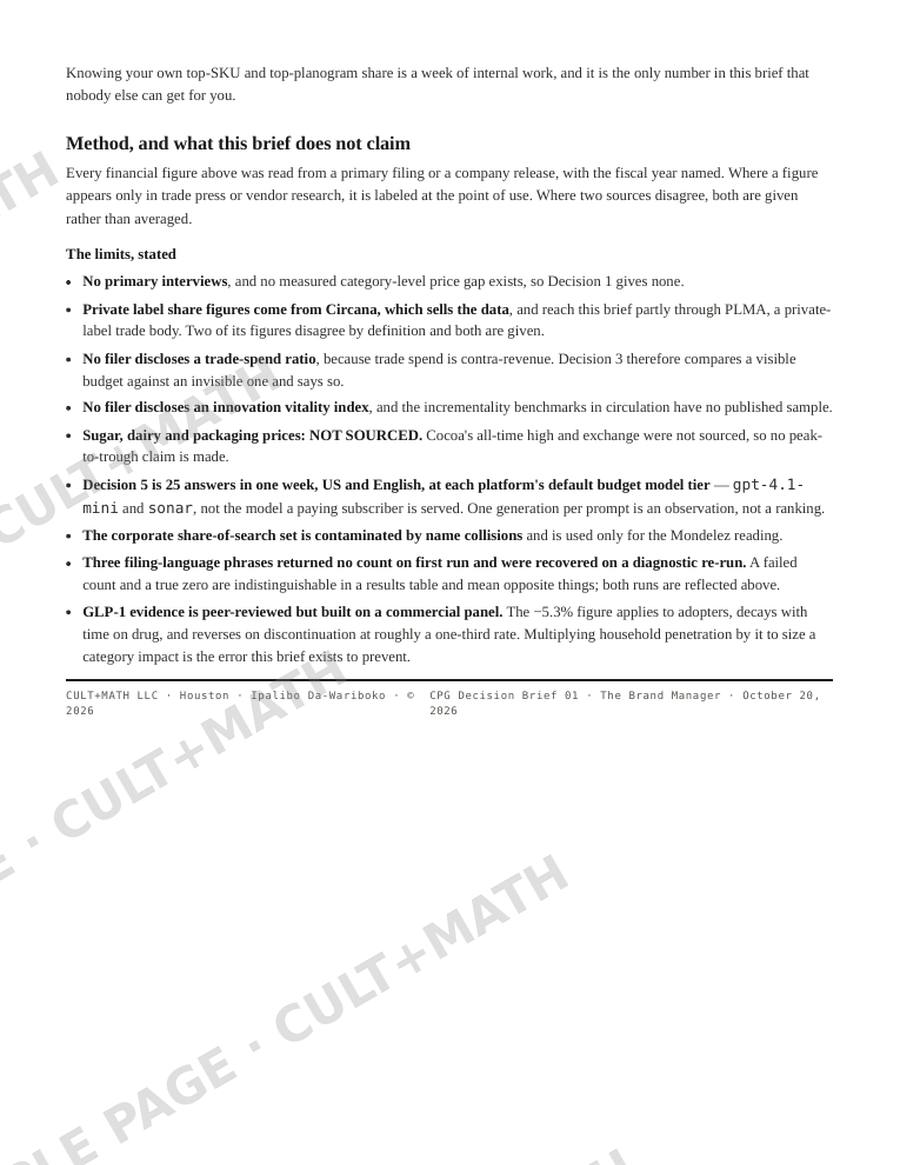
Every figure is sourced. Where a number could not be sourced, the brief says so and gives none. Where two sources disagree on direction, it says that rather than picking the flattering one. Where a widely quoted statistic comes from a party with a commercial position, it is flagged — including where that flag weakens a point the brief is making.
The decision-maker and every decision were fixed before any source was read, and were not revised to fit what came back.
The catalog briefs answer the decisions a category shares. A custom brief answers yours: one decision, one decision-maker, your market, with the question and what would prove it wrong registered before any data is pulled. See the custom brief, $995 →
Licensing. A $495 brief is licensed to one named reader — read it, quote it inside your organization, build on it in your own planning. To share the PDF across your organization, buy the team license ($1,495). No brief may be resold, published in full, or redistributed outside your organization. Quoting a figure externally is fine with attribution to CULT+MATH and the as-of date, which is the part that makes the figure meaningful.