You are being asked to fund AI visibility. Two platforms can both score 100% stable — and name different winners.
Six decisions your executive team is making right now — and the evidence on each
Written for the CMO or VP Marketing being asked to fund AI visibility — the seat holding the budget line, and the seat that has to defend the number upward. Each decision names the seat that owns it and the seat that contests it, and the brief closes with what your CEO, your CFO and your board will say when you bring it to them.
Walk into the budget meeting with all six calls made, the evidence on each, and the questions your CEO, CFO and board will ask already answered.
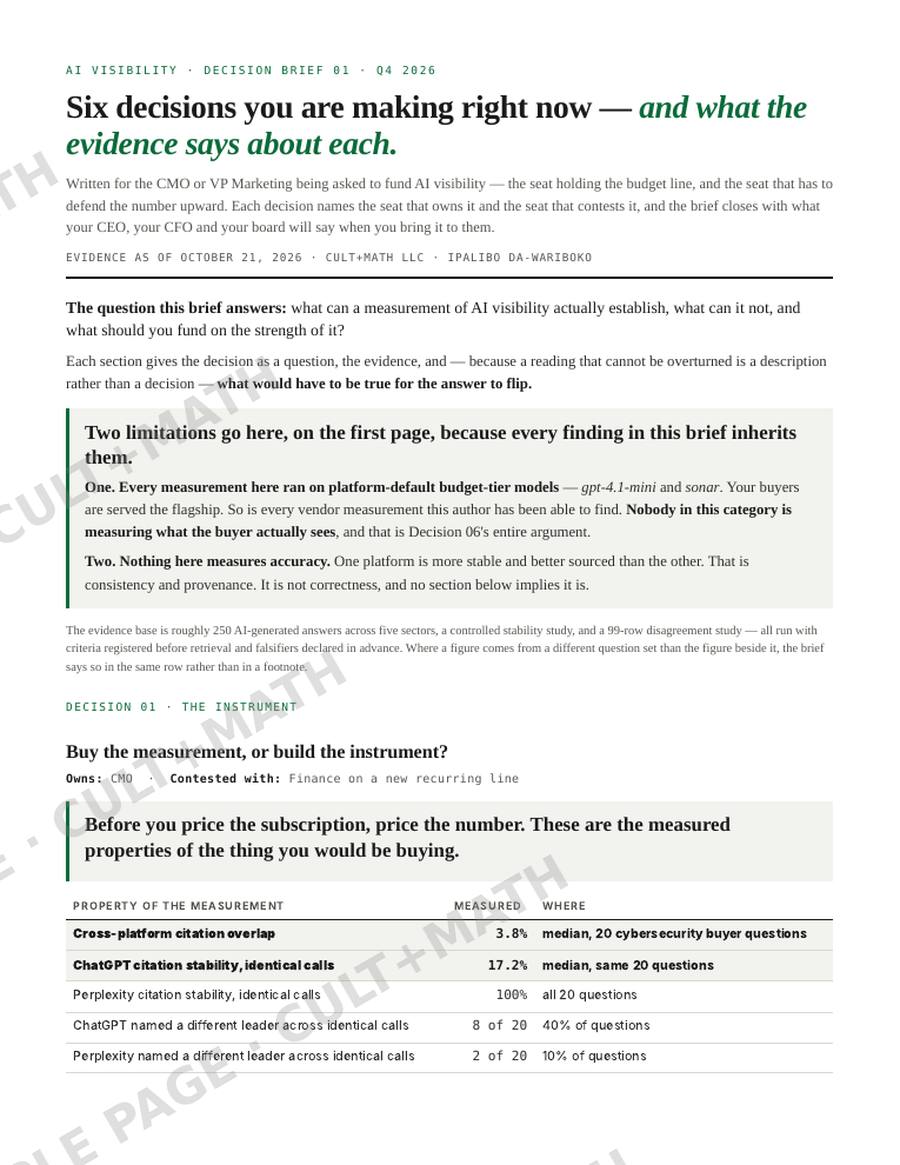
Asked the same question three times each, one platform named one answer every time and the other named a different answer every time. Both were 100% stable. Two measurement vendors running on different platforms would each report a clean repeat rate, name different winners, and neither report would name the platform. Both internally consistent, both unfalsifiable from the report alone. That is a governance problem, and it lands on the seat presenting the number.
What is in it
- Buy the measurement, or build the instrumentCMO, contested with Finance on a new recurring line. Before pricing the subscription, price the number: cross-platform citation overlap at a median 3.8%, one platform's citation stability at a median 17.2% against the other's 100%, and a different named leader across identical calls on 40% of questions. The instability is itself unstable — 12.5% in the morning and 50.0% five hours later, same model, same question.
- Which platform to optimize forCMO with the content lead, contested with SEO on where effort goes. On buyer-intent questions in one measured category the two platforms named a different leading vendor on 72.7% of questions. Measured separately across three entertainment categories, source overlap ran 4.1%, 5.7% and 4.2%. Roughly 95% of what each platform cites, the other does not.
- Reallocate the analyst and review budget, or holdCMO, contested with the analyst-relations owner. Sector-dependent and the range is enormous: in cybersecurity the registered review corpus was reached on 11 of 20 questions, with G2 in 14 rows and Gartner in 9; in ERP, across twenty-five generations, G2, Capterra, SoftwareAdvice, Gartner and SelectHub were cited zero times. Every figure prints with its own corpus and row count, and no blended cross-sector number is published.
- Place into the corpus these models read, or decline toCMO with Comms, contested with Brand. A vendor's own paid-newswire release surfaced as the top recommendation to a buyer, in an answer that also drew on a Japanese SaaS listing and an Italian software reseller. At the other end, one review desk cited once moved a recommendation away from the best-selling cereal in the United States.
- What to report upward, and at what confidenceCMO, contested with the CEO and the board. The sharpest finding in the evidence base, and a governance problem rather than a measurement one. A visibility figure should carry its platform, its model tier and its date, and should be a range across repeats. A single number with none of those attached is not a measurement; it is a draw.
- Whether to act at all this cycleCMO, alone, contested with every vendor in the category. Every measurement here — and every vendor measurement the author has found — runs on platform-default budget-tier models while buyers are served the flagship. Retrieval went from 3 of 15 rows to 15 of 15 on the same model and configuration four hours apart. This is the decision no vendor will present, and the one the evidence most clearly supports.
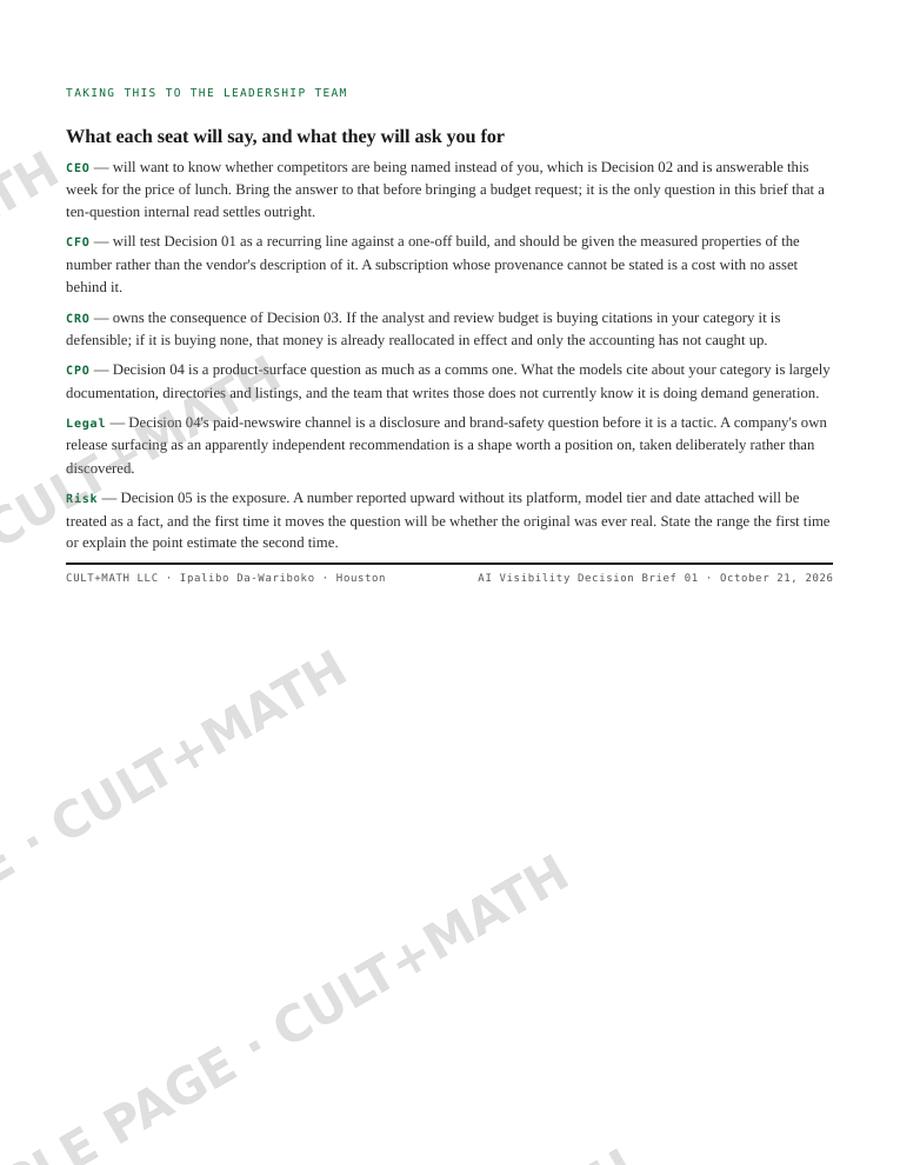
It closes with the executive decision matrix — CEO, CFO, CRO, CPO, Legal and Risk — each with something specific to do in this category, not a generic lens.
Two sample pages: the opening and the leadership close
Read two of the questions in full, free, before you buy: How should a CMO measure whether their brand shows up in AI search results? · What tools measure AI search visibility for a brand?
14-day guarantee. If the brief does not change or sharpen a decision on your desk, reply to your receipt within 14 days for a full refund. One refund per organization.
For comparison: Profound Growth is $399 a month billed annually — $4,788 committed up front. Peec Advanced is $495 a month. This is one month of the tooling you are deciding whether to fund.
Stripe receipt for expensing · card, Apple Pay, bank, Affirm or Klarna
What it is not
- Not a vendor ranking. It measures decisions and evidence, not which company is better.
- Not a forecast. Where something is an observation of one window, it says so.
- Not a market-size report. It will not tell you what any of this is worth to you in revenue.
- Not padded. 7 pages because that is what the evidence filled.
How the evidence is handled
Every figure is sourced. Where a number could not be sourced, the brief says so and gives none. Where two sources disagree on direction, it says that rather than picking the flattering one. Where a widely quoted statistic comes from a party with a commercial position, it is flagged — including where that flag weakens a point the brief is making.
The decision-maker and every decision were fixed before any source was read, and were not revised to fit what came back.
The catalogue briefs answer the decisions a category shares. A custom brief answers yours: one decision, one decision-maker, your market, with the question and what would prove it wrong registered before any data is pulled. See the custom brief, $995 →
Licensing. A brief is sold for use inside the buying organization — read it, quote it internally, build on it in your own planning. It may not be resold, published in full, or redistributed outside your organization. Quoting a figure externally is fine with attribution to CULT+MATH and the as-of date, which is the part that makes the figure meaningful.