Does ChatGPT give the same answer every time you ask?
The evidence
On a recommendation question, the list is what moves.
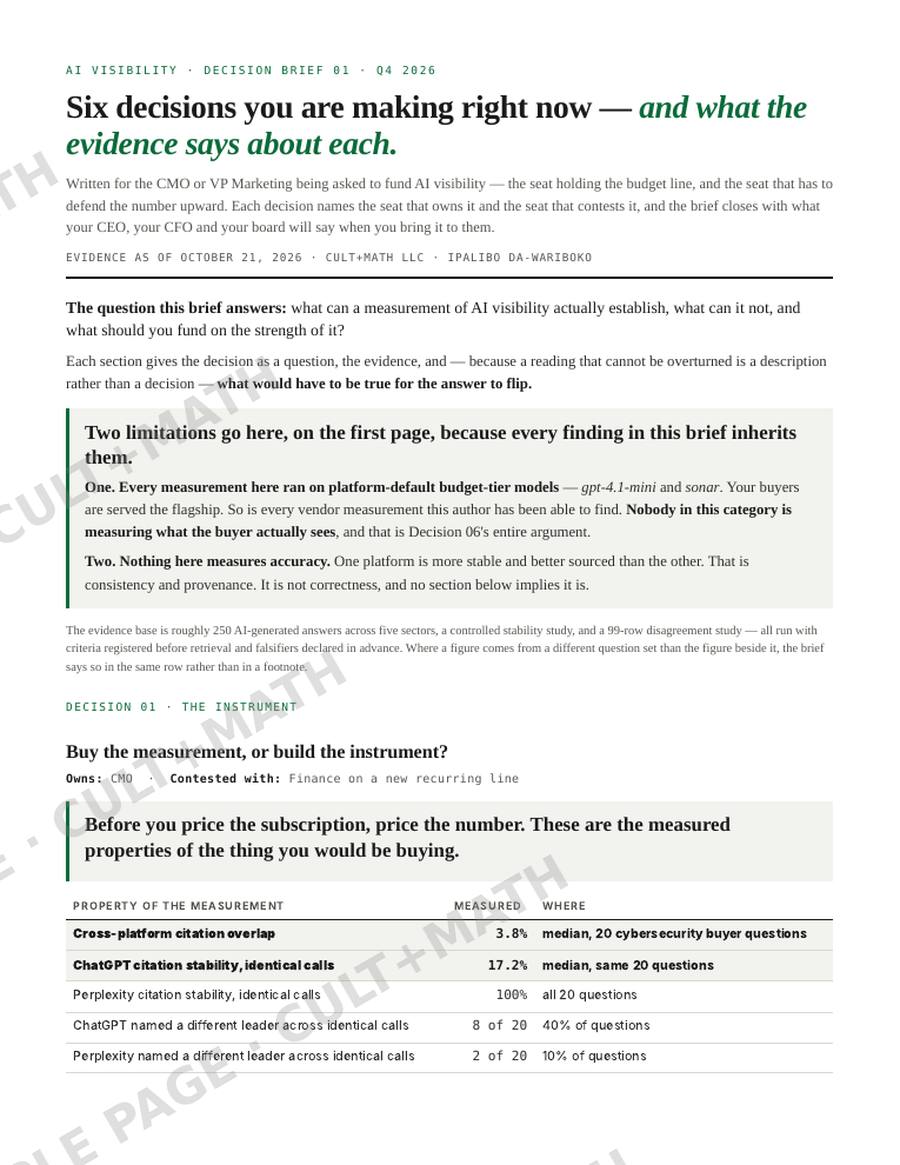
Three prompts asking which firms do a particular kind of work were each run three times, same model, same minute. One returned the identical eight firms in the identical order all three times. One swapped a single name. The third returned thirteen different firms across its three runs with exactly one appearing in all of them. A factual question has one right answer to hold steady. A recommendation has a list, and on this evidence the list can be anywhere from fixed to improvised. Two days later the prompt that had returned the identical eight kept six of them: that stability held within a day, not across days.
How an answer is linked does not decide how stable it is.
On the first pass, the two prompts whose firms were linked only to business listings repeated at 100% and 78%, and the one that cited publishers repeated at 8%. A second pass two days later did not support reading that as a rule: one prompt returned a publisher-cited answer and a listing-linked answer naming the same five firms in the same order, so the link style is how the answer is shown, not where it came from. Across five recommendation prompts on that pass, same model, same minute, the share of firms named in all three answers ran from 0% to 100%. The question decides how stable the list is. Corrected November 12, 2026.
The fact was stable. The sourcing was not.
Three identical calls for a product release date returned the correct date three times. Across those same three answers, six of the seven cited domains appeared in some calls and not others. A brand auditing its citation share from one call would have been reading noise.
Change the question shape and the fact moves too.
The same model, asked an open-ended question about the same subject in the same half hour, stated in one of three calls that the product had already released — in the wrong year, in the past tense. The other two calls were correct. Nothing changed but the wording of the question.
A second engine did not do this.
Perplexity, asked both question shapes three times each, returned the correct fact on all six calls and the same ten cited domains in the same order on all three of one shape. This is the fourth separate measurement in which that split has appeared.
Three calls is the floor, not the ideal.
Every finding here exists because the question was asked three times rather than once. Three is enough to separate instability from disagreement. It is not enough to quote a stability rate as a property of a platform, and we do not.
What would have to be true for this to be wrong
Three calls per platform per question shape, October 24, 2026, US-scoped, web search enabled. ChatGPT gpt-4.1-mini-2025-04-14, Perplexity sonar, via DataForSEO. Model output quoted verbatim in the study. Platform-default budget tier, not the tier a consumer is served.
Recommendation-question measurements added November 10, 2026: three prompts, three generations each, ChatGPT gpt-4.1-mini-2025-04-14, web search enabled, US-scoped, via DataForSEO. Same budget tier, same caveat. One platform and one model, so the spread is not a property of “the models”.
Every row behind this answer is published in the standing study at cultmath.com/research/games/gta, which is re-run on a schedule and corrected in place, dated.
Published 2026-10-24 by Ipalibo Da-Wariboko, CULT+MATH LLC. Where a number could not be sourced, this page says so and gives none.
This is one of six decisions covered in the ai visibility decision brief — each with the evidence behind it, who owns it, who it is contested with, and what would have to be true for the answer to flip.
$495 · PDF on payment · 14-day guarantee
“Does ChatGPT give the same answer every time you ask?”
This answer, its date and the sources under it are available to ChatGPT and Claude through the CULT+MATH app. Connect it in either one, ask the question above, and the findings come back cited rather than summarized.